


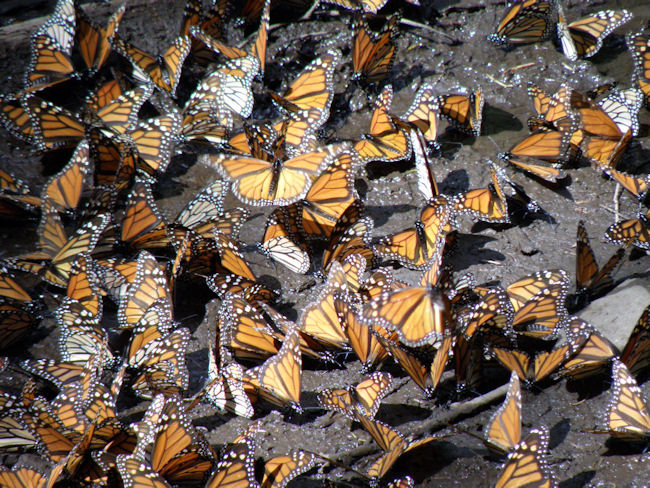
| Hace unos días, me topé con unas mariposas que se dejaron fotografiar. Al principio dudé si eran Monarcas o Virreyes. A pesar de haber visitado el Santuario de la Mariposa Monarca algunos años atrás, recordaba muy poco acerca de esta especie, por lo que decidí investigar un poco y compartirles lo más sobresaliente. (Por cierto la Virrey se distingue de la Monarca por una franja negra que atraviesa su ala.) Estos bellos insectos son nativos de Norteamérica, aunque se han introducido a Hawaii (donde la presión evolutiva ha resultado en una variante blanca), Oceania y las Azores, y ocasionalmente cruzan el Atlántico y visitan Europa Occidental. Se distinguen de las demás mariposas por dos comportamientos atípicos. El primero es la migración anual Norte-Sur (la única otra mariposa en realizar un viaje similar es la Vanesa que viaja entre Europa y el Norte de Africa). El segundo es la longevidad de cada cuarta generación, conocida también como la generación Matusalén. Las Monarcas nacidas en primavera y verano viven tan solo algunas semanas, lo cual es bastante normal entre las mariposas. Sin embargo la última generación nacida a finales del verano puede vivir hasta siete meses, o más. Esta generación es la que migra desde Canadá y Estados Unidos para invernar en Michoacán y el Estado de México. El viaje total puede superar los 4,000 km en algunos casos, y puede tardar un mes o más. Entre bosques de Pino y Oyamel, se reúnen por millones, incluso cientos de millones para pasar el invierno. Llegan al mismo sitio, sin haberlo conocido antes. Han pasado tres generaciones enteras desde su última visita, por lo que es imposible que ¨recuerden¨ el camino. Y sin embargo, navegan a la perfección, llegando incluso a los mismos árboles que sus tatatatarabuelos. Meses después, pasado el invierno, emprenden el camino de vuelta hacia el Norte. Cabe recalcar que no todas las poblaciones de Monarcas migran. Y que hay otros destinos en California donde otras poblaciones pasan el invierno. Sin embargo, las reunidas en el Santuario de la Mariposa Monarca cada invierno representan aproximadamente la mitad del total de todas las Mariposas Monarcas. Y tristemente el número de Monarcas que llegan al Santuario cada año, ha disminuido cada uno de los últimos 8 años, y el censo del invierno pasado (2012-2013) resultó en el menor conteo de la historia. Aunque es de esperarse que las poblaciones de insectos oscilen en altibajos vertiginosos, la tendencia con las Monarcas últimamente carece de recuperaciones que interrumpan la disminución anual, lo cual es preocupante. Es probable que el deterioro se deba a dos causas principales, una local y otra más generalizada. La primera tiene que ver con pérdida de h‡bitat. A pesar de ser una Reserva de la Biósfera, el Santuario de la Mariposa Monarca ha sufrido de excesiva deforestación debido a la tala ilegal. Aunque parece que se ha logrado frenar esta actividad en los últimos años, los daos ya causados no se han revertido. La segunda tiene que ver con el uso de pesticidas agrícolas. Parece que las mariposas, junto con las abejas, son víctimas inocentes de la agricultura moderna. |
Mariposa Monarca
Monarch Butterfly
Danaus plexippus
Monarch Butterfly
Danaus plexippus
| A few days ago I ran into some butterflies that practically posed for photographs. At first I doubted whether they were Monarchs or Viceroys. Though I visited the Monarch Butterfly Sanctuary a few years back, I remembered very little about this species, so I decided to do a little research and share what I found. (By the way, Viceroys a have a black band across their wings that Monarchs do not.) These beautiful insects are native to North America, although they have been introduced to Hawaii (where a white variant has evolved), Australia, New Zealand and the Azores, and they occasionally cross the Atlantic to visit Western Europe. Two atypical behaviors distinguish them from other butterflies. The first is their annual North-South migration (the only other butterfly to embark on a similar journey is the Painted Lady which travels between Europe and Northern Africa). The second is the longevity of every fourth generation, known also as the Methuselah generation. Monarchs born in Spring and Summer live only a few weeks, which is normal among butterflies. However, the last generation born in late summer can live up to 7 month, or more. This generation migrates from Canada and the USA to winter in Michoacan and the State of Mexico, in Central Mexico. The total journey can be over 4,000 km in some cases and last over a month. In forests of Pine and Oyamel Fir, they gather by the millions, even hundreds of millions to spend the winter. They arrive at the same site, without having seen it before. Three whole generations have passed since their last visit, so it is impossible that they ÒrememberÓ the way. And yet they navigate perfectly, arriving at the same trees as their great-great-grandparents. Months later, once the worst of winter has passed, they return North. It is worth noting that not all populations of Monarchs migrate. And that there are also wintering sites in California. However, those that gather at the Monarch Butterfly Sanctuary represent about half of all Monarchs. And sadly, the number of Monarchs arriving at the Sanctuary each year has dropped each of the last 8 years, and last winter´s count (2012-2013) was the lowest in history. Although wild up-and-down swings are expected in insect populations, lately there have been no recoveries to interrupt the downward annual trend. And that is worrisome. It is likely this downward tendency is due to two main causes, one local and one more widespread. The first has to do with loss of habitat. Although it is a Biosphere Reserve, the Monarch Butterfly Sanctuary has suffered from deforestation due to illegal logging. Although it seems this activity has been reduced of late, the damage done has not been reverted. The second has to do with the use of agricultural pesticides. It seems that butterflies, like bees, are innocent victims of modern agriculture. |
| Photos and text by David Nuñez |




| Recomendamos estos libros sobre la Fauna de México. (Los nuestros son bilingues.) |
| To learn more about the Wildlife of Mexico, we recommend the following books. |


| DONDE VERLOS: En verano es posible ver ejemplares en gran parte del país (particularmente en el centro y norte), así como en EUA y el Sur de Canadá. Para atraerlas puede intentar cultivar Asclepia en su jardín. Pero en invierno hay que viajara Michoacán y el Estado de México para verlas reunidas por millones. Son tantas que se escucha su aletear, como el murmuro de un arroyo. Lo más facil es viajar a Morelia y de allì tomar un tour al Santuario de la Mariposa Monarca. |
| WHERE TO SEE THEM: In summer you can see individuals in most of Mexico (particularly in the north and middle of the country) as well as in most of the USA and Southern Canada. To attact them you can try planting Milkweed in your garden. But in winter one must travel to Michoacan or the State of Mexico to see them gathered by the millions. There are so many that you can hear their wings moving, like the murmur of babbling stream. The easiest way to see them is to head to Morelia, and from there catch a tour into the Monarch Buttefly Sanctuary. |
|


